

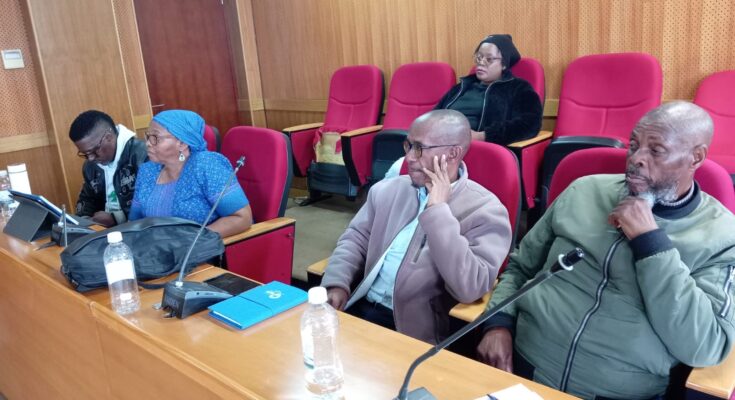
At the social cluster meeting with inter-ministerial Ex-miners working group meetings the ministry of Health tabled the framework for Occupational Health Services (OHS) before the parliamentary committee, DPE, TRC, Justice and Peace, Cabinet, Office of the Master of the High Court, Ministries of Labour and Employment, Foreign Affairs, and National Security Services. Ministry of health explained that occupational health refers to the promotion and maintenance of the highest degree of physical, mental, and social well-being of workers in all occupations. This definition set the foundation for the day’s discussions. The meeting referenced key instruments to guide Lesotho’s approach: Agenda 2063, African Mining Vision, SADC protocol on mining, the 2012 SADC Declaration on Tuberculosis in the Mining Sector, and the 2015 SADC code of conduct on TB in the mining sector. Under Agenda 2063, health and safe workplaces are integral to aspiration1 and goal 3 on inclusive growth and citizen well-being.

The Ministry of Health (MOH) confirmed it currently has no legal documents guiding occupational health services in Lesotho. This gap continues to hinder regulation, enforcement, and service delivery. Chairperson indicate that Basotho workers frequently do not receive compensation after sustaining workplace injuries. There are also concerns that some foreign employers, particularly Chinese firms have been accused of using bribes to avoid liability, leaving injured workers without medical support or financial reimbursement.
MOH said they will push hard to strengthen the health sector using the frame work being tabled before the social cluster committee. They indicated that efforts will be intensified to develop and implement a legal framework that supports occupational health delivery, compliances, and oversight. Also clarified the role they play in occupational health plus objectives. Their main role is improving the universal access to OHS countywide, strategic planning, supervision and integration of occupational health services, supervision of private health institution and other ministries offering OHS. Collaboration with the ministries responsible for labour and mining in primary prevention initiatives where necessary. And performing Hazard Identification and Risk Assessment, (HIRA) occupational risk exposure. Its objective is to describe the national occupational health services policy arrangement, provide guidance on good practices, tools methods and competences, on surveillance of workers health and workplace. Describe infrastructure and human resources for OHS.
Ministry of labour and natural resources mine department work intertwines manner their roles and responsibilities are closely linked and depend on each other. They can’t fully do their HIRA and monitoring and evaluation work separately. Outline the expected role of ministry of Health and inter-ministerial coordination and accountability.
Speaking on behalf of civil society Mr. Molibeli from DPE said that, to date, occupational health in this country remains a disaster. He suggested that there should be a formal record keeping or filling system that documents when specific issues were first raised. This would help avoid repeatedly discussing the same problems, as the ministry of health has been talking about this issues for a long time without resolution. He further noted that there appears to be resistance within the ministry of health to ensure that these matter are fully implemented. This observed during the presentation where there is no budget for OHS for the implementation hoping that during the presentation of supplementary budget the ministry will consider that.
The chairperson stated that, at the next meeting the committee will invite the principal secretary and the legal team to facilitate ratification of the framework to establish a concrete roadmap for implementation. He also highlighted that occupational health issues tabled by the ministry of health were not included into the current financial year budget. Also expressed concern that civil society is no longer performing its role and is not as active as it used to be. He added that with the support of civil society, they would be able to work much more effectively.
